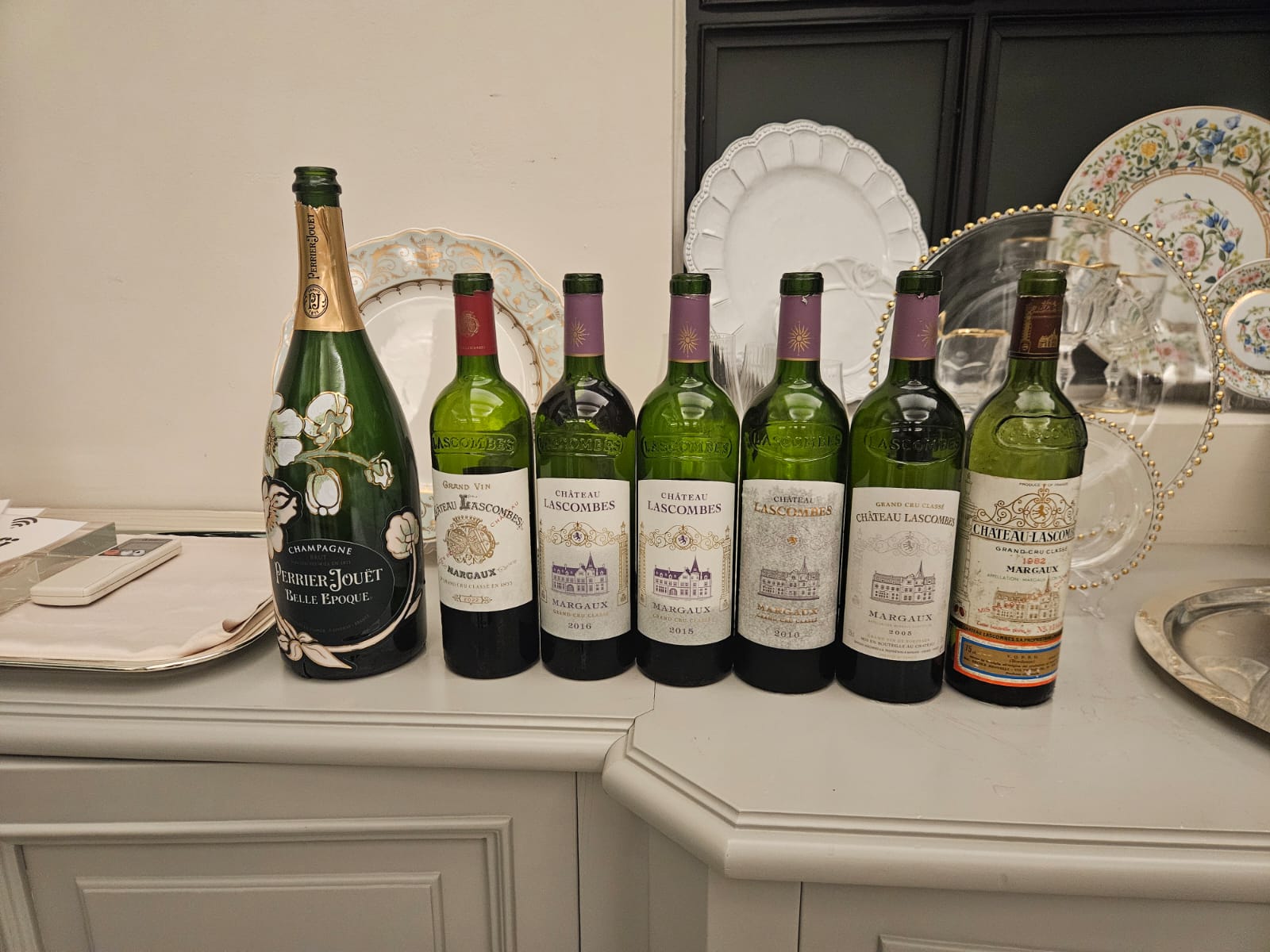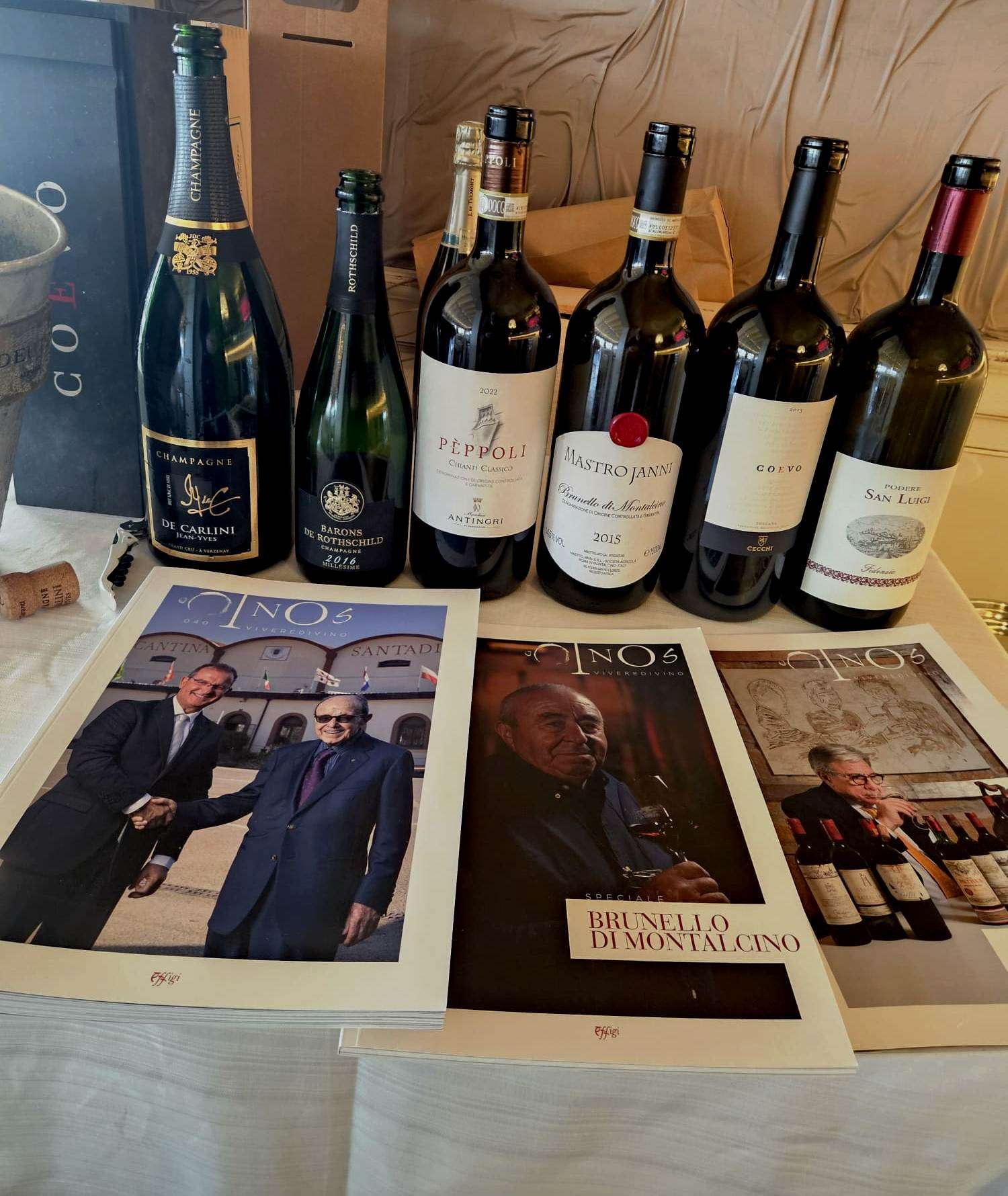

Last March, my friend Piero Benvenuti invited me and some other friends to lunch at the “Salotto Portinari” restaurant, and each of us brought a bottle of wine to enjoy.
Piero had fun serving some wines blind, without letting anyone see the bottle during service.
Vito prepared dishes for us that would go well with the wines that would be served.
The Portinari lounge was stunning, as was the table set aside for us. Liudmila Musatova, Piero Benvenuti, Stefano Amerighi, Francesco Tanzi, Aldo Fiordelli, Francesca Testi, Anna Paclet, and myself were present.
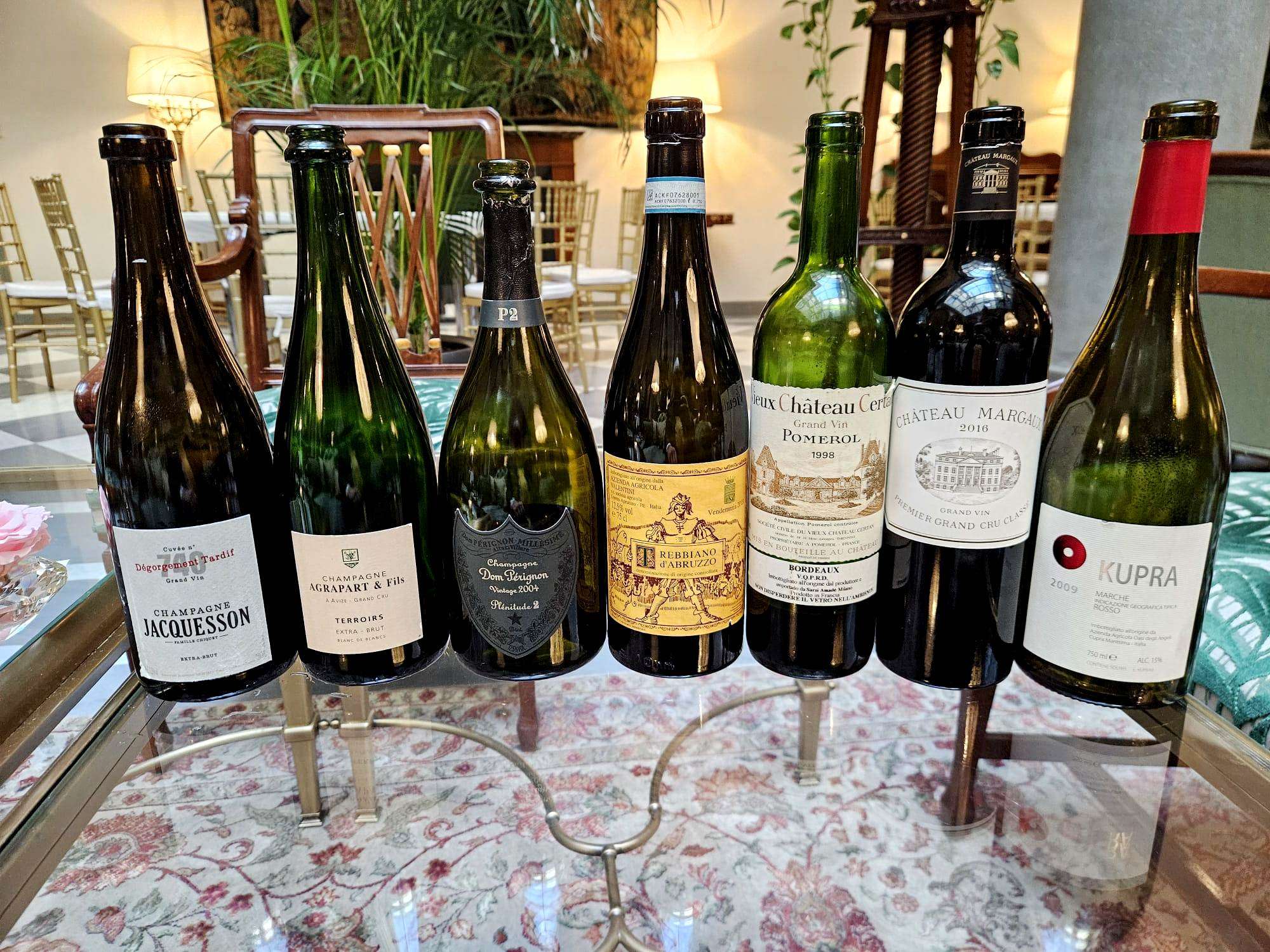
As an aperitif, with some appetizers, we drank the Agrapart Terroirs champagne, which was pleasant for its mineral notes. Next, we drank the Jacquesson Cuvée 740 champagne, dégorgement tardif, which isn’t my ideal champagne because, both on the nose and on the palate, it’s very woody.
At the table we were served the first course: “Royal oyster, apple and caviar soda, sea urchins, white potato mousse, red prawns with citrus fruits”, which was paired with the Dom Perignon champagne, Plènitude 2, 2004 vintage, which, with its sapidity and minerality, was perfectly paired with the dish.
Followed by “wild herb risotto with quail and almond ragù” which was paired with the 2018 Valentini Trebbiano d’Abruzzo.
The pairing was not at all easy because, in my opinion, the wine was too young and too demanding, both in terms of aroma and taste, compared to the dish.
With the “veal brain saltimbocca” we were poured what I call a wine-poem: the 1998 Vieux Chateau Certan, a Pomerol rich in pleasantness that paired beautifully with this delicate dish.
With the “steamed egg with pigeon ragù and comté foam” we were blindfolded and served a fine and elegant wine that perfectly complements the pigeon ragù: the 2016 Chateau Margaux.
This was followed by another wine served blindfolded with “Poularde de Bresse, Morels, and Black Truffle.” The wine was difficult to identify; it was the 2009 Kupra, a Marche wine made with 100% Grenache. On the nose, it had a green note, and on the palate, the tannins were a bit drying. The dish was excellent, and the wine, in my opinion, didn’t live up to the dish.
To finish, Vito had us prepare an excellent zuppa inglese.
As always, these lunches are very interesting and enjoyable, for the company, the atmosphere, the food, and the wines.
I’ll move on to describing the wines tasted, making a preliminary note about tannins, which normally concern red wines.
Regarding the width of the tannin, it’s important to clarify the following points so it can be understood. I taste the tannin in the wine on the upper gum. The total width of the tannin is 6/6, that is, the entire width of the upper gum. Obviously, if the tannin is less wide, it could be, for example, 5/6, and so on. The width of the tannin is important when its quality is good or high. The wider the tannin, the more worthy of attention the wine is, but the tannin, as I specified, must, in any case, be of good quality.
Let’s now move on to describing the wines we tasted.
AGRAPART & SONS HOUSE
TERROIRS, Grand Cru, Blanc de Blancs
Extra Brut S.A.
Golden yellow in color, the bubbles are fine and quite numerous.
Mineral, banana and brioche aromas rise from the glass.
On the palate the body is medium and the bubbles are fine.
A well-balanced wine with a freshness that completely envelops the alcohol. Its finish is long, but not overly long.
(93/100)
JACQUESSON HOUSE
Cuveé n. 740, Degorgement tardif. Extra Brut S.A.
(blend: 53% Chardonnay, 29% Pinot Noir and 18% Pinot Meunier)
It has a bright golden yellow colour with fine and fairly numerous bubbles.
On the nose, the woody notes stand out, with both green and ripe banana, citrus fruits and minerals in evidence.
On the palate, it is medium-bodied and has a woody flavor. Freshness dominates the alcohol, making the wine well-balanced. Since this champagne is heavily influenced by wood, its tannins dry out the upper palate.
Wood is the characteristic of this champagne, which doesn’t excite me.
Its taste has a long persistence.
(90/100)
Dom Pérignon House
Plénitude 2, vintage 2004
(blend: 60% Chardonnay and 40% Pinot Noir)
It has a bright golden yellow colour, with fine and fairly numerous bubbles.
Olfactory mix of lemon tea, flint, hints of green banana, rennet apple, chamomile, hints of peanut, finishing with puffs of warm starched cloth.
Savory and minerally on the palate. Medium body, although it tends to settle a bit towards the finish. The alcohol-fresh balance is balanced with a mineral, lemon tea finish. Its intense, long-lasting flavor lingers.
(94/100)
VALENTINI FARM
TREBBIANO D’ABRUZZO, 2018 vintage
(blend: 100% Trebbiano)
Straw yellow color with golden reflections.
An intense nose of tannery leather and boiled rice starch is followed by notes of lemongrass, minerals, raisins, and the sweetness of the outside of a candy cane, finishing with hints of vanilla. When empty, aromas of zabaglione and peanut butter emerge.
On the palate, it’s medium-bodied, savory, and has a mineral and tanned leather flavor. A fairly balanced wine, with the alcohol content slightly peeking out over the freshness. The upper gums feel a bit dry.
Its persistence is long with a finish of India ink, a very, very young wine that will need to balance more with the time spent in the bottle.
In my opinion, it is a wine that will need to rest in the bottle for a few years to give its best.
My score is with a view to future improvement.
(94/100)
CASTLE OLD CASTLE CERTAN
POMEROL, vintage 1998
(blend: 85% Merlot and 15% Cabernet Franc)
Light garnet red with orange rim.
Olfactory variety marked by aromas of cherry, mint, eucalyptus, light notes of juniper berry, violet, finely processed tannery leather, boiled rice starch, finishing with intense puffs of black olive.
The body is medium-sufficient plus and the wine is perfectly balanced with the freshness that envelops the alcohol mass. The tannins are sweet, broad (6/6–) and silky.
Its taste has a long persistence. (94/100)
CHATEAU MARGAUX
MARGAUX, vintage 2016
(blend: 94% Cabernet Sauvignon, 3% Cabernet Franc, 2% Merlot and 1% Petit Verdot)
Intense ruby-purple red coat.
Nose punctuated by aromas of black cherry, mint, eucalyptus, blood orange, chocolate, blackberry, cassis, black pepper with final caresses of nutmeg.
On the palate it has a medium body, not excessive, and has a perfect balance between alcohol and freshness.
The tannins are sweet, broad (6/6), and silky. Its intense aromatic persistence is long.
It is a typically Margaux wine that tends more towards elegance than power.
I remember that 2015 was, for me, superior in structure to both 2016 and 2014, while in terms of the breadth of the tannins 2016 is superior to both 2015 and 2014.
(95/100)
OASIS OF ANGELS COMPANY
KUPRA, vintage 2009
Marche red IGT
(blend: 100% Grenache – called Bordeaux)
Garnet red coat with orange edge.
Olfactory attack oriented towards the scents of mint, eucalyptus, camphor, black olive, carob, chinotto and ending with green references.
On tasting, you perceive a medium body and a good balance between alcohol and freshness, while the tannins are sweet, quite broad (5/6), initially velvety, then drying out and burning the upper gum a little.
Its taste has a long persistence.
It left me a little perplexed by the green note perceived on the nose and the quality of the tannins which I found quite drying.
(90/100)
As always, it was a pleasant lunch, thanks to the food, the company, and the wines. Thanks to Vito, Piero, and all the other guests.