
A few months ago I was invited by Gaetano Gulli, who, with his company Relais e Terroirs srl, based in Lucca (www.relaisterroirs.com), also imports and distributes Maison Boulard Bauquaire champagnes in Italy.
Gaetano asked me to hold a seminar on champagne dosage, tasting three champagnes with different dosages. The event would take place in Lucca, at the Real Collegio di Lucca, as part of the GC Show event organized by GeD Food and Beverage, a distributor of products from various food and beverage companies. The tasting would also be attended by the owner of the Maison, Christophe Boulard.
The Maison is part of the Recoltant Manipulant category. Located in Cormicy, 20 km from Reims, it covers an area of approximately 8 hectares and cultivates three grape varieties (Chardonnay, Pinot Noir, and Pinot Meunier). The Maison produces approximately 80,000 bottles annually in the Massif de Sainte Thierry, Montagne dè Reims, and Vallée de la Marne areas. This Maison has existed for eight generations; these passionate and independent winemakers oversee all stages of production, respecting the Champagne tradition and the environment. Recoltant Manipulant (RM) identifies small producers who, in addition to owning and cultivating their own vineyards, oversee all stages of the production process, from cultivation to harvest, bottling, and marketing.
Since 2021, the Maison has been producing a limited number of bottles of “Les Fervins” vintage champagne on a “Lieu-dit” parcel in Verzy Grand Cru. This cuvée is composed of 50% Pinot Noir and 50% Chardonnay, with a dosage of 0.8g/l.
The House produces 9 different types of champagne: Tradition, Nature, Grande Reserve, Rosé, Carte Noir, Vieilles Vignes, Rosé de Saignée Coeur de Pinot, Cuvée Melanie and Les Fervins – Vintage.
Now, before talking about the dosage, let’s briefly talk about the stages of champagne production.
PRESSING: occurs immediately after harvesting with whole bunches and is carried out in a slow and fragmented.
DECANTATION: clarification of the juices by sedimentation and then racking.
FERMENTATION: a) alcoholic, i.e. the transformation of sugars into alcohol;
b) Malolactic (it is optional, not all maisons implement it) which is the transformation of malic acid into lactic acid.
BLENDING: with different crus, different grape varieties, different vintages and reserve wines.
TIRAGGIO: bottling of the blend which takes place from the 1st of January of the following year at the harvest. Normally tirage liqueur is added (sugar, yeast and riddling agent.
FOAMING AND MATURATION: it is the second alcoholic fermentation that taking place in a closed bottle, it allows the carbon dioxide produced during the process refermentative to remain in the wine, determining the typical foam. The pressure is 6 bar at 20°C. Autolysis of the yeasts occurs and provides the aromas. Maturation occurs subsequently in the cellars which is different between the vintages and the not vintage.
REMUAGE: is the rotation of the bottles which are upside down, a procedure which takes place in Manual or mechanical. The lees concentrate in the neck of the bottle.
DEGORGEMENT: the neck of the bottles is immersed manually or mechanically in an ice-cold solution at a temperature ranging between 20 and 30°C degrees below zero, to freeze the sedimented yeasts, creating a block of ice that traps them. The crown cap is removed thanks to the internal pressure of the bottle. All this guarantees clarity and the final effervescence.
DOSAGE: is the addition of dosage syrup to give the champagne its note recognition. There are those who do not make this addition but simply add the usual wine (dosage 0). The liqueur d’expedition is essentially made up of must rectified concentrate or wine (vin clair de champagne), sugar (cane or of beetroot), rarely also a distillate, often aged wine.
The French were certainly the first to use the term more markedly. residual sugar according to customer tastes. We were talking about Russian taste (350gl), English taste (between 20 and 50g/l), American taste (between 100 and 160g/l), German taste (between 250 and 300 g/l).
CORKING AND CAGEING: the cork stopper is placed, the capsule of the cage and the cage. Rarely in place of the metal cage is the string that the French they call it “a l’ancienne”.
HABILLAGE: this is the last phase, the capsule (aluminium or tin cap), the label and the back label are added.
Let’s get back to dosage, talking about residual sugar. This is the unfermented sugar remaining in the wine at the end of fermentation, measured in grams per liter.
Pas dosè and Brut Nature is less than 3g/l
Extra Burt from 0 to 6 g/l
Brut from 6 to 12 g/l
Extra dry from 12 to 17 g/l
Sec, secco of dry from 17 to 32 g/l
Demi-sec or sweet from 32 to 50 g/l
Sweet or Doux major at 50 g/l
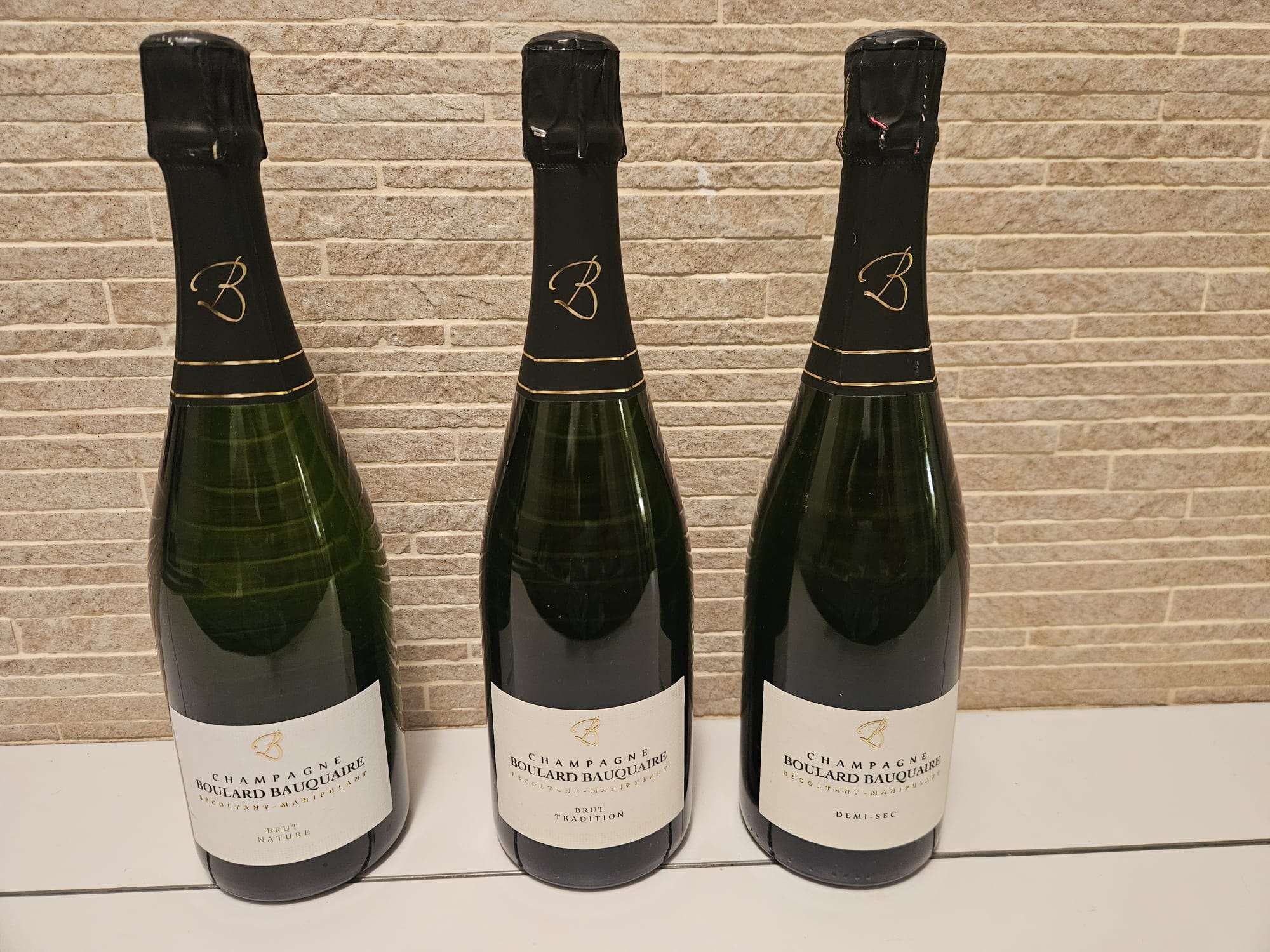
The champagnes at the tasting were as follows:
Brut Nature, with 0 g/l residual sugar
Brut Tradition, with residual sugar 7g/l
Demi Sec, with residual sugar content of 26g/l
CHAMPAGNE BOULARD – BAUQUAIRE
BRUT NAURE SA
(blend: 40% Pinot Noir, 40% Chardonnay, and 20% Pinot Meunier, 50% reserve wine. Residual sugar content 0g/l)
It has a golden yellow color with gray hues while the bubbles are quite fine and numerous.
A bouquet of toasted bread, flint, ripe rennet apple, vanilla, boiled chestnut skin, and iodine, finishing with sweet notes reminiscent of the outside of a sugared almond.
On the palate it has a medium body, quite sufficient, fine and pleasant bubbles and is savoury and mineral.
The freshness completely envelops the alcohol content. Its palate has a fairly long finish. This is a Champagne that extends more in breadth than in depth.
(89/100)
CHAMPAGNE BOULARD – BAUQUAIRE
BRUT TRADITION IN
(blend: 40% Pinot Noir, 40% Chardonnay, and 20% Pinot Meunier, 50% reserve wine. Residual sugar content 7g/l)
Fairly intense and bright golden yellow.
The bubbles are fine and quite numerous.
The olfactory baggage evokes intense aromas of green banana peel, followed by rust, Kaiser pear, red apple and chalk.
On tasting, the bubbles are very fine and the wine has a medium body and is savoury.
The alcohol and freshness balance is in perfect harmony. Its intense aromatic persistence is long.
Tradition has more structure and persistence than Nature.
(90/100)
CHAMPAGNE BOULARD – BAUQUAIRE
DEMI-SEC SA
(blend: 40% Pinot Noir, 40% Chardonnay and 20% Pinot Meunier, 50% vin de réserve. Residual sugar 26g/l)
It has a bright golden yellow colour and the bubbles are very fine and numerous.
The olfactory casket opens with scents of rennet apple, candied pineapple, candied ginger, pear, green banana peel, ending with puffs of starch (spray starch for ironing).
The palate is caressed by fine bubbles, a medium body, and a sweet, vanilla flavor. A well-balanced wine with freshness dominating the alcohol.
Its taste has a long persistence.
(90/100)
The dosage amount is a matter of personal taste. Some people prefer a dosage of “0” and others prefer a fairly high dosage.
For me it would be unthinkable to drink a champagne with a high dosage as was done in the past.
It was a pleasant and constructive experience in which we understood the olfactory and gustatory diversity of the typologies, depending on the different dosages.